One rule, every variant, reused.
A product configurator that generates thousands of valid codes from a few dozen database rows, reads any code back, and hands its catalog to the next system. Client anonymized.
The problem
One product line has thousands of variants: size, housing, ring, LED module, colour temperature, control gear, sensor, emergency pack. Every combination is a real, orderable product with its own article number. The naive build, one database row per finished product, doubles every time you add an option, drifts out of sync, and still cannot turn a pasted code back into a configuration.
The design: a grammar, not a table
The article number is a positional grammar. Each segment is resolved from a catalog row, so the code space is the product of the axes, computed on demand. There is no variant table.
Add one option and the whole space grows, with no migration and no table to rot.
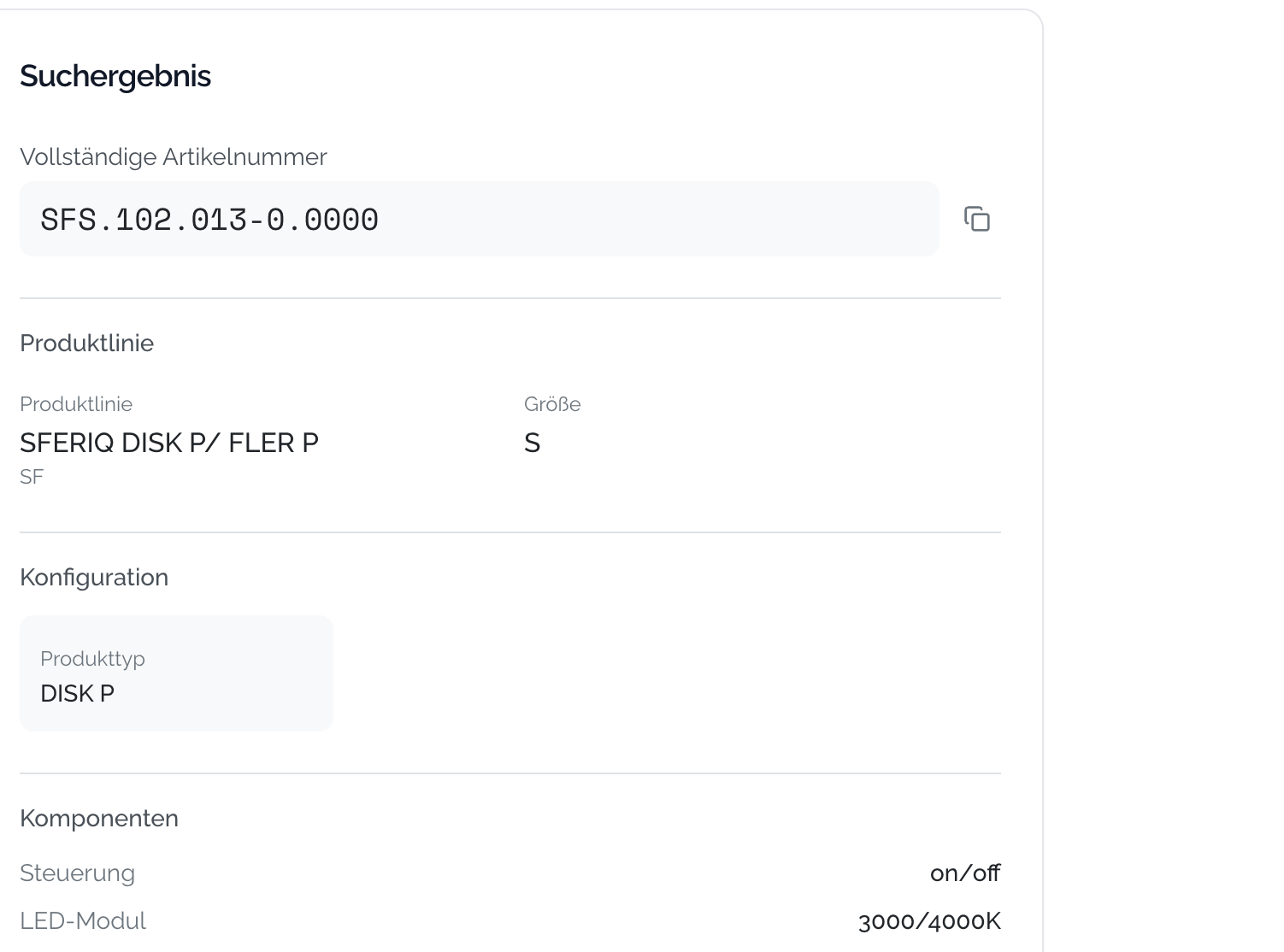
And it runs in reverse
Paste any article number and the same grammar decodes it: product line, size, and every component, straight from the code. Generation and lookup are one rule read two ways.
Why it compounds
The catalog and codes are exposed as an API. That API became the product source of truth for a second system I built, the tender matcher, which reads it to match public-procurement notices to products.
Model the axes, not the combinations. Get the data model right and the hard things get cheap: thousands of codes from a handful of rows, decodable, and reusable by the next system you build. When systems are built to match how the business actually works, one system's output becomes the next one's backbone.
Honest scope: the configurator is live; the article-number grammar and the reverse lookup are shipped and shown above. The catalog API is real and consumed by the tender matcher. Code counts are the encoding space per line, from the catalog's own axes.
Sitting on data that could feed more than one system?
Bring the decision to a paid session and receive an external assessment with a written recommendation.
View the decision session →Watch the companion video and read the component-model notes →
Back to: a system that sees itself →